Showing posts with label #runswedish. Show all posts

Friday, November 3, 2017

Salming Distance 5 Review

Salming Distance has been with Salming since the very first start and was awarded best debut by Runners World when it first was released. So what has happened over the years with Distance? Distance became immediately my favorite Salming shoe. The fact that Distance worked really for my faster day, longer days and for race day, got me hooked. Salming original was streamlined had a three layer upper that wrapped you foot perfect. Over the two next editions, Salming tweaked a bit with the uppers and lost some of streamlined feel. Version 2 felt a bit too wide and 3 a bit too long for me. Then out of the blue, a few months after D3 was released, Salming released the all black D4! The original feel was back, this time with a two layer upper and with a more responsive Runlite midsole. Now D5 has been out for a while and the original feel is still very much there. Introducing  Todd Baranoski (instagram Todd_ultrarunner) who will also give his opnion on D5!
Salming Facts:
  • Weight: 8oz 
  • Drop: 5 mm
  • Color: Gecko Green
  • Gender: Men
  • Stack: 21,5 mm center of heel 16,5 mm ball of foot
  • Midsole: Runlite™
  • Outsole: Lite rubber
  • Torsion: Torsion Efficiency Unit™
  • Lining: Mesh
Allow yourself the pleasure of covering long distances with Salming´s best selling natural running shoe. With great durability and a 5 mm heel to toe drop, this shoe is designed to help you overcome both long distances and hard surfaces.
The improved RunLite™ midsole compound offer great responsiveness. A two-layer sandwich upper construction deliver a very comfortable feel while keeping your foot stable through the exo skeleton feature. Let your feet experience the light, natural feeling – even on long distances!


RunningSwede says: 
As mentioned above, D5 has the same feel as D4 and the original feel of the original Distance. Upper is streamlined with a simple structured mesh and the Exo Skeleton to keep foot in place. What I like is the simplicity of this upper. Its just enough and at the same time very functional. I always get the feeling that this is a racing flat, which is true, but it can be used for so much more. If you could only 
 have one shoe, this would be it. Its enough for long days, tempo/work out days and race day. The new lighter and more responsive Runlite works really well for all this categories of running and it is very responsive. A torsion unit in the mid foot helps you with some stability and heel/toe transition. I have used Distance for marathons and recently I used D5 for the last 10 miles of a trail 50K race. D5 would be light enough for a fast 5K but also give you enough protection for a marathon without slow you down. I often get the question what shoe can you compare Salming to. D5 would be comparable with Adidas Adios/Boston, Nike Elite and New Balance 1400.

Todd's opinion: 
 Being primarily a trail runner my first shoes with Salming were their Trail shoes which I love and carried me across thousands of training and race miles. Since I kinda came into their shoes from different direction than most people I wanted the same awesome fit and feel to match for a daily road trainer. That being said I’m a huge believer in matching trail shoes to the road shoes. You don’t want to have to change your cadence or style to get the same speed out of your shoes. That is also how I recommend shoes to people that ask me, as a set to use together. The D series especially the D5’s are that shoe to me. With the D5’s I get a seamless transition from D5’s for fast road  training and the T3’s for fast trail running. Yet the I still use them for the odd road race I do. I can’t wait to see what upgrades Salming come up with the D series to help get even faster.


Where do Salming go from here?
Salming Distance is the back bone, the soul of Salming Running line up. The shoe has been with Salming since the beginning, without any major changes and it breathes the feeling Salming slogans are saying, #nononsense and #naturalrunning. Maybe Salming should give the Distance a major facelift like they did with Speed5/6? I could actually see Race and Distance as one shoe, to get a more of a marathon racer. Salming can do this without loosing the feeling of Distance and Race, and at the same time cover the gap in the line up for a true marathon racer........


Disclosure of Material Connection: I receive Running shoes from Salming Running USA as part of their brand ambassador program. I was not required to write a positive review. The opinions I have expressed are my own. I am disclosing this in accordance with the Federal Trade Commission’s 16 CFR, Part 255: “Guides Concerning the Use of Endorsements and Testimonials in Advertising.”


Saturday, August 5, 2017

Salming Ambassador Todd Baranoski

 Salming Ambassador Todd Baranoski

Recently some of the Salming Ambassadors started a Face Book group for all Salming athletes worldwide. Here I have been talking to some of Salming's  amazing talented #nononsense athletes/ambassadors world wide that I would like to present here on my blog.
First out is Salming's smiling Canadian Todd Baranoski. Todd is an amazing ultra runner, who runs crazy long races and always smiles. Todd is also a great guy who always is helpful, always take his time to answer questions regarding Ultra running and trail running. Todd is also one of the few Salming ambassadors who has seen Borje Salming play Ice Hockey live!

How and when did you start running?
I first started running around age 7-8 in Northwestern Ontario where I went for the summers working at my Uncle’s tourist camp.  We would go to his private cabin in the summer when there wasn’t a lot of people in camp for a couple days to relax, or into minnow lakes where we would trap minnows for the guests to use for fishing, or what we call walk in fishing lakes, these were the only accessible by a walking trail a few miles long.  Sometimes I would run the trails that were for the quads to bring in supplies as it was in the middle of nowhere on a remote lakes with the closest civilization a couple hours away.  There was only so much room on the quads and that was taken up by supplies.  So who was ever with my uncle would have to walk.  Or in my case I would run sometimes.  I would race myself each time in and out.  


Running the trails in the heart of the Canadian Shield to Randy Lake in the big Jack and Spruce Pines, no underbrush except some blueberry bushes and ferns, the rest a very barren green moss covered landscape under the canopy of trees, going over all the rises and coming out at the peaceful lake, no one around waiting for everyone is still some of my most vivid childhood memories.  
I ran through school and the Army the odd time after but really started in July 2013 at 41 years old with my first ½ marathon in the early fall of 2013 and running with my first Ultra(50k) in May 2014.  So I’m relatively still new to running compared to most people.

What's your favorite distance and race and why?

Currently 100k is my favorite distance, type is single track trail, point to point with some good gains.  I think I like it because it seems to be my current level I can comfortably run the entire distance.  I can really push myself at that distance without having to worry about keeping a big reserve of energy. My favorite race so far is Cruel Jewel(did the 56 mile this spring) in Georgia.  I loved the incredible trails, tremendous amount of gain(17,000 ft of gain) without going over 4500ft in elevation, very well organized with incredible people volunteering at the aid stations.


How many miles per week do you usually do?
Typically anywhere from 45-60 on average miles of week with a peak of around 70-80 with different types of runs.  That seems low but because some of my runs I do are not long runs but goal runs.  As an example for hill training my goal for that day will be 1500ft of gain which is about 3 miles where I do my hill training.
My goal is be able to run 100 miles/week consistently I’m hoping I can get there by this time next year.
Where do you typically run, track, roads or trail?
It’s typically around split 70/30 trail to road.
How is Ultra running different from regular running, how does training difference?
That’s hard to explain because everyone is different and have access to different terrain to train.  
#1 the distance of the trail races or Ultramarathons is a guideline not an absolute distance.  A 10k trail will be over by a km.  If it’s a 50k it may really be 55k, a 100 mile race may really be a 106 miles.  The RD don’t apologize for it. lol.  It’s a guideline but never shorter.


 " Nothing will end your race
 earlier than not being prepared
 for hills."
I live in the prairies of Canada. I don’t have easy access to running mountains or large hills.  So a lot of my training involves hill training in one form or another.  The ability to run up and downhill (downhill running is harder on your body than uphill) is incredibly important.  Nothing will end your race earlier than not being prepared for hills.  I train a week at a small ski hill( I mean small) with 50% grade close by and I believe tire drag with a 50 lbs tire also helps me with hills and speed.
Running trails for long runs to me is next on the list but just as important as hill work.  Learning to run on uneven rocky, rooty, muddy trails that go up and down efficiently is a skill that must be mastered.   Everyone that starts to run trails trip and fall a lot at the start.  Learning to pick up your feet especially when you’re tired is a hard transition from road running.

 Speed work is just as important as with road racing.  The ability to run fast is directly influences time on feet for both road and trail on what you require of your body.  Fast though is proportional to each type of running.  But why be out there for 30 hours when you can be out there for 24 hrs.
Finally, Fuel and Hydration is big.  On road marathon a person has to worry about 2-5 hours of hydration and fuel.  The needs are required for road, it is different in comparison to someone that is doing 50k-100 miler, depending on the race and where it’s held can be 18-24 hours of on your feet for the first place finisher.  A person needs to learn how to maintain their energy for that many hours.  It’s a lot of trial and error process because everyone is different and how their GI will handle it over a long period of time.
What's your favorite workout?
If you mean gym I don’t work out or strength train except maybe in December when I take a little break from running but that’s mostly to tone up and don’t really take it serious.
If you mean running, my favorite and most dreaded is Tire drag runs.  I think it has a real benefit to hill running and to my overall speed.
How do you plan your running? Coach, book plan or self coached?
Kinda self-coached for now.  Currently I take a lot of information off the internet of what the elites do and try to incorporate into my training schedule.  I’ll make a schedule up in the beginning of each year from what I’ve learned on what I need to work on and then try to put my weaknesses into my schedule.  Even with that it’s always changing and adapting during the year to what I feel what my body can handle.
I know to get to the next level I will need to get a coach that fits into my running attitude and philosophy.
How would you describe yourself as a runner?
Driven-Dedicated


Goal race for the fall? And what's your goal for that race?
If haven’t picked on yet one yet but getting close on deciding, It will be 100 miler.  My goal is to run a sub 24hrs.  
When did you first hear about Salming and Salming Running?
Great story.  Early winter of 2015 I was looking for new trail shoes.  They ones I was wearing where to minimum and just didn’t feel right.  I researched for months.  I went to all the running and outdoor stores in Winnipeg trying on shoes that were available to try.  The usual suspects Saucony, Brooks, Altra’s, Hoka, etc etc.  Each one didn’t feel right.  Especially the Altra’s and Hoka’s.  I looked on line and reads hundreds of different reviews on shoes and comparison charts.  I came across Salming in a review for trail shoes.  They were reviewed with a bunch of shoes.  I read the review and thought what the hell.  They are everything I’m looking for.  I called customer service, Laura was awesome as always, and explained that I would love to try their T1’s but wondered if there was a discount available. I explained that with the dollar difference and shipping charges I was worried that they would be another shoe that I wear for 100 miles and put in the closet with others that just doesn’t work for me.  Laura said no problem I can give 20% off to help. 


 " I read the review
 and thought what the hell.
 They are everything I’m looking for."

 I said that’s awesome thank you.  This was December 22nd 2015, I still have the emails and it’s hilarious how happy I was for the 20% off. January rolled around and a new training schedule started.  I ran every run on the one pair them.  Inside, outside -30C, treadmill, stairs, speed. etc. for the month of January. They were incredible. Been running in Salming Shoes ever since.


How long have you been an ambassador?
February 2016
What's your favourite Salming shoe and equipment?
For road hands down is the Distance 5.  Best shoe all around.  Perfect combination for lightweight for speed but still have enough cushion for long runs.
For Trails has been the Trail series of shoes.  Each model gets better and better and more versatile for different terrain and types of trials.
I wear the most is the Grey Salming running jacket.  Perfect for everything.
I like wearing the short racing shorts but mostly for shock effect. Lol  
The Salming Running Long Sleeve tee shirt is awesome.  Makes for a great middle layer in winter and great spring and fall shirt.
I know I would love the Salming running Beanie.  I would cut off the pom pom.

What does #nononsense mean to you?
Don’t train half assed.  Train to improve each time. Leave everything you have on the road or trail.
How does Salming Running fit in, in today's running industry?
I see Salming as a no gimmick running shoe company that make high quality shoe that lasts longer than the competitors.

How do you promote Salming as an ambassador?
Interactions on line or in person.  I try to post a lot with races and what I use to race in, that seems to go a long way to promoting.   I try to finish well on all my races to help a lot to promote them.  I will get asked for my opinion about running or if someone is having injury issues I will suggest trying Salming shoes.  I find it key that is if someone is have issues with their shoes to get them to see they have nothing to lose in trying them.
How do you see Salming grow in the future?
I see Salming becoming a mainstream shoe over the next 5 years as it become more widely known.  Especially in Canada.
You have actually seen Borje Salming play hockey in person, what do you remember and what can you tell us about the experience?
When he played for Toronto Maple Leafs in the mid 80’s, not exactly sure what year, they played against Winnipeg Jets(my team) in the old barn. My dad took me for my birthday present and Winnipeg happen to be playing the Leafs.  I was pretty young at the time.  Even though the game was played in Winnipeg there is always a huge Toronto following in the arena when they showed up to play.  I remember him being cheered on a lot during the game from the Toronto fans.  I remember looking up his number up in the program and asking my dad how to pronounce his name. lol he wasn’t sure either.  When I saw him playing in person he certainly stood out on the ice.  You need to have some skill to see it on the ice with a lot of great players out there.  
Funny how 20 years after first learning of Borje Salming from hockey and respecting his hockey skills I’m an ambassador wearing his shoes.

Sunday, March 5, 2017

Salming Speed5 Review


Salming Speed5
For 2017, Salming Running has decided  to do a total make over of Speed, one of Salmings original line up shoes. Speed has been my to go shoe for faster runs and the marathon distance. A snug, low to the ground and light shoe that have served me really well. The new Speed5 is something totally different. With Speed5, Salming are placing Speed in the same category as their new shoe EnRoute, but Speed is a hair lighter then Enroute. They both are built on the same last, with some minor differences. EnRoute has a softer cushion and a torsion unit in the midfoot. Speed5 is more firm and does not  carry the same torsion unit. The uppers in the both shoes are totally different.  Here are some of Salmings data regarding Speed5:
  • Weight: 8.7 oz (US 10 Men)
  • Drop: 6 mm
  • Color: Ceramic Green/Black (Men)
  • Color: Shocking Orange/Dark Orchid (Women)
  • Stack: 22 mm center of heel 16 mm ball of foot
  • Midsole: Recoil™ + Recoil R™
  • Outsole: Durable lightweight rubber
 https://shopsalmingusa.com/products/salming-speed-5-shoe-men-ceramic-green-black


Salming Speed3 in the background

 Upper:
Salming are using two different types of mesh in the upper. In the the midfoot, together with the EXO Skeleton we see a very thin, firm mesh. Same mesh has been used on earlier Speed as the third layer, but server here as a single layer. You can literally see straight thru the shoe.  Together with the Exo Skelton the midfoot is very secured and at the same time the mesh breathes very well. I could see how this mesh can benefit a triathlete who need good drainage. 

The toebox of Speed is wide and offer a more softer mesh, to avoid hot spots. The toes get a lot of room to spread out. The wide toe box takes away the snug fast feeling, the original Speed offered the runner. Speed offer a soft thick ankle collar that protects and heel does not slip.
Together with the snug fit in the midfoot area and the wide spread toebox you get a nice fit, but it does not feel as fast as the name Speed should, more like a performance shoe.
 EnRoute upper kind of looks like the old Speed upper so maybe the EnRoute upper would have been more suitable for Speed5 and the other way around?

+ Nice mid-foot wrap, with open mesh

-Too wide toe box for my like, feels like toe box and mid-foot wrap are not synchronized together.


Outsole/Midsole
Speed and EnRoute are built on the same last, with a Recoil compound as the main ingredients. While EnRoute offers more cushion, Speed5 has a more firm Recoil solution. The firmer Recoil works better when you pick up the pace, but can be a bit harsh on your legs at lower paces. Speed does not have the same torsion unit as EnRoute, instead its built in, like Salming Miles, in the Recoil material for a better heel-toe transition. Speed5 and EnRoute share the same outsole pattern, blown rubber. The rubber cover most of the parts of the outsole and offer good grip on pavement, wet and dry. Of course Salming 62%/75 degree approach is in cooperated in the midsole/outsole. With first flexgroove after 62% of the shoe in a 75% degree for a natural flex . The flex grooves are deep and offer a great flex in the fore foot that works with your transition.

+Firm ride, but need to be high pace to take advantage
+Great flex in the forefoot

-At the same time the firmness of this shoe can be to much when you run easy pace.
-Could see a more aggressive outsole pattern, for a faster feel.

EnRoute on the left, Speed5 to the right


Over All/Ride
Speed has got a bit of a cult status back in Europe and Sweden, so I can see how many runners questions the extra weight and "more shoe". Speed5 is more in the performance category now and Salming D5 will represent the brand in the marathon flat category, as D5 have lost some of its weight. The new Race5 is also like a good option for the runner who seek the old raw"Speed feeling".

As mentioned above the ride of Speed5 is firm and responsive, according to me, this is a shoe for the faster days, not the recovery day or easy miles. I have now over 50 miles on my Speed5 and I feel the Recoil foam has started to ease up a bit, so my conclusion is that Speed5 needs some break in time. This is my second shoe from Salming that are using the Recoil foam, Miles was my first shoe. I hope Speed5 Recoil offers the same durability as my Miles. My first pair of Miles has now over a 1000 miles and still going strong. If I can get 1000 miles out of a pair of performance shoes, that would be fantastic!

Salming Speed5 is very close to Salming EnRoute and I can see how Salming wants to build on the EnRoute momentum and have a faster option for those runners who are using EnRoute as their daily trainer. To get an even more faster feeling of Speed5 I would have loved to see a more streamlined upper.


 Disclosure of Material Connection: I receive Running shoes from Salming Running North America as part of their Salming brand ambassador program. I was not required to write a positive review. The opinions I have expressed are my own. I am disclosing this in accordance with the Federal Trade Commission’s 16 CFR, Part 255: “Guides Concerning the Use of Endorsements and Testimonials in Advertising.


Thursday, February 16, 2017

Salming 2017 Overview


Salming enRoute Men


enRoute: This is an awesome addition to the Salming  line.  Very lightweight, yet with premium cushioning. Incredible dual density midsole makes for a very responsive and snappy ride. The only shoe available in multiple colors.  High recommend.  Size up half size in the enRoute!
www.believeintherun.com/2016/12/12/salming-enroute-running-shoe-review www.roadtrailrun.com/2017/02/salming-enroute-review-and-comparisons.html


Salming Miles Men
Miles: This is our heaviest shoe,and robust. Despite this the Recoil midsole material offers a great energy return and a pop feeling. You can easy pick up pace with Miles, it feels lighter on the run.  Any Florida Gator fans out there will love the men’s color scheme.  Great daily trainer, you will get upwards of 600-1000 miles in this shoe.
http://shopsalmingusa.com/collections/mens-running-shoes/products/salming-miles-shoe-men-electric-blue
 http://www.runningshoesguru.com/2016/05/salming-miles-review/
 www.believeintherun.com/2016/04/10/salming-miles
Salming Distance D5 Men
 Distance D5: The Distance is the shoe that put us on the map, after being named the 2014 Runner’s World Best Debut.  Check out reviews of the D4 for an idea of how this shoe will perform, D4 for was more of a preformance trainer. Some tweak on the upper, with a wider toebox. D5 could be your best friend on marathon day.  Great trainer or race day shoe.
http://shopsalmingusa.com/collections/mens-running-shoes/products/salming-distance-d5-shoe-men-gecko-green


Salming Speed 5 Men

Speed 5: The Speed received a complete makeover this year, and it now is without question my favorite shoe in the lineup. I have used both Speed 2 and 3 as my Boston shoe and are looking forward to again use Speed for this year. Now with the new Recoil midsole, that will give extra energy return.
   http://shopsalmingusa.com/collections/mens-running-shoes/products/salming-speed-5-shoe-men-ceramic-green-black
Salming Race 5 Men


Race 5: This shoe will get you noticed, especially at night with its completely reflective upper.  Great for tempo work or those 5k – 10k races. In the past some of our elite ambassadors have worn it during marathons. 
 http://shopsalmingusa.com/collections/mens-running-shoes/products/salming-race-5-shoe-men-ceramic-green


Salming Trail T3 Men


Trail T3: Great all terrain and all round trail shoe. Very sticky grip but can be used on just about any surface, including asphalt.  The T3 was designed to keep water out.
 http://shopsalmingusa.com/collections/mens-running-shoes/products/salming-trail-t3-shoe-men-shocking-orange-deep-blue
Salming Elements Men


Elements: A more robust trail shoe with a very aggressive tread.  Best for OCR, single track trail races.  Designed to let water out. Drains exceptionally well.
http://shopsalmingusa.com/collections/mens-running-shoes/products/salming-elements-men
 www.runnersworld.com/shoe/salming-elements-mens
 www.runningscotland.com/single-post/2016/04/21/Review-Salming-Elements

Sunday, July 24, 2016

Salming Distance 4 Review

Salming Distance 3 was recently released and I have not had a chance to review that edition yet. Rumors started that Salming D4 limited edition was going to be released during the summer. Sure enough pictures started to leak out of an "all black" shoe called D4. D4 was first released in Europe and a couple of weeks later in USA. A little bit of a strange release as D3 was recently released and Im not quite sure why. One thing I know, Im glad they did. Its such an great update.

Salming Speed, Distance and Race have been around for three years now, with only few tweaks as updates for each edition and year. Salming D4 Limited Edt is the biggest update so far on the Salming Running original shoes, not Miles or the trail shoes included.

In this update you will find all the technologies from the earlier editions: Runlite (update, lighter and more responsive)  Exo Skeleton, Torsion Efficiency Unit, TGS 62/75


Upper
D4 has a 2 layer construction instead of 3 as the earlier editions of  Distance had and is to the most part seamless. The upper feels a lot lighter and hugs the foot in a less compressed way. As mentioned above the foot is secured by a 2 layer construction and the Exo Skeleton helps to secure the foot from moving to the sides. It has been a very hot and humid summer here in NJ, and the D4 has been handling it very well, the mesh feels light and breathable In some case the overlays on running shoes can interfere with the shoes mesh and the breath-ability. The D4 has minimal and strategical overlays that does not interfere.

 Im allergic to brands who does not pay attention to the laces. Salming does a great job with the laces and D4 ones has stayed tied. They are on the  thinner side and can cut in on top of your feet if you laces them to hard.

Color, D4 limited edition comes in an "all black color with some red details, kind of a stealth look. Its either you hate it or love it. I love the black color but Im aware that black might not work for everyone, its personal preference.


Midsole/Outsole 
The biggest change when it comes to the midsole is the new Runlite midsole material and the new outsole material TOC66 (Traction Outsole Control 66). Its now lighter, has a more responsive feel to it and are more flexible. I hate to use the sentence "the shoe feels faster" but that's just the way the new Runlite midsole material and the shoe makes you feel. With the responsiveness and flexibility you get a less restricted toe off and a smoother flow.

The rest of the midsole/outsole stays the same, you find the same Torsion Efficiency Unit as older version of Distance and the same outsole traction pattern. Ive now 90 miles on my D4 and so far no wear and tear on the outsole.


Sum Up
Its a weird release for sure but Im very excited. D4 brings more joy to my run. Its a great update that makes sense. Salming has done small tweaks over the years on the Distance, but D4 is the first one were you can really tell the difference. You will still find the same original idea behind the original Distance, but D4 has now received a well needed face lift,

Distance 4 is now a great contender to other brands marathon racing shoes, like Adidas Adios Boost and New Balance RC 1400. D4 feels lighter, more responsive and it feels like the shoe comes more to life, compare to older versions of Distance. D4 is like a Distance with a Turbo Charger! 


Ive used D4 to all kind of runs and D4 can handle them all. I wouldn't hesitate at all to take D4 the full 26.2, or just use it as my daily trainer. You can throw anything on D4 and it can handle it all.

Now since  D4 is closer to a marathon racer, I'm curious what will happen to my old Salming marathon/tempo shoe, Salming Speed!

http://shopsalmingusa.com/products/salming-distance-d4-men-black-red


Disclosure of Material Connection: I receive Running shoes from Salming Running North America as part of their Salming brand ambassador program. I was not required to write a positive review. The opinions I have expressed are my own. I am disclosing this in accordance with the Federal Trade Commission’s 16 CFR, Part 255: “Guides Concerning the Use of Endorsements and Testimonials in Advertising.

Tuesday, April 26, 2016

Salming Miles Review

Salming Miles Review
Salming Miles is a brand new shoe from Salming Running, meant to go the long distance. According to Salming: "The purpose of the Salming Miles running shoe is to add a more cushioned shoe without compromising the Salming concept and principles. It is built to stand the tear and wear of long distance asphalt and tarmac running. Miles has a Drop 4mm construction but compared to the popular and award winning Distance model, Miles has more heel and fore foot cushioning and the new responsive Recoil midsole compound."


Miles is compared to the Salming's other trainer "Distance". To me "Distance" is more of a performance shoe. When comparing Miles with Distance  its a big difference. Miles is a lot of shoe. When I say a lot I mean a lot of everything, I will go in detail under each section of the shoe. Distance is more snug and has a more performance oriented feel to it.

Weight: 11.4oz, size 9 US
Drop: 4mm
Stack Height: 25mm heel - 21mm forefoot

Before this review, I have used "Miles" during my Boston training, so far I have put over 300 miles on my pair.

Disclosure of Material Connection: I receive Running shoes from Salming Running North America as part of their Salming brand ambassador program. I was not required to write a positive review. The opinions I have expressed are my own. I am disclosing this in accordance with the Federal Trade Commission’s 16 CFR, Part 255: “Guides Concerning the Use of Endorsements and Testimonials in Advertising.

Upper
Miles offer a seemless upper made out two layers of mesh , plus the " Exo Skeleton" that keep the foot in place. The upper is very roomy with an oversized toebox for a great toe display. At first I did not like how the mesh kind folded unnaturally in the forefoot but after a few "break in runs" it seems like the mesh has adopted to my foot or molded itself after my foot if you like.
The toebox is very roomy and there is plenty of room for your toes to display. When looking at the upper it seems like its a lot going on. When I first saw pictures of "Miles" I thought "man that is a lot of overlays". The darker blue stripes has no function its just part of the visual design.
Laces are of a strechy round fabric, that helps to secure the fit. Salming did not go cheap on the laces, they offer probably the longest laces I have ever seen........


Midsole/Outsole
Salming offer a new midsole compound called Recoil. After 300+ miles the Recoil still looks like new. Recoil makes Miles shine, the shoe weight is about 11oz but with the energy return that Miles
offer the shoe feels lighter while you're running. You can easy pick up the pace with Miles and take advantage of the Recoil midsole energy return. 
Miles has a lot of outsole rubber and deep lugs, according to Salming website the lugs are 8mm deep. The thickness of the rubber feels a bit overkill to me. According to the website the outsole should provide great grip on "gravel, rocks and roots" as well. As I understand this shoe is built for roads in mind and I cant quite understand why Miles has these deep lugs and amount of rubber. The durability of the rubber has been great but is on the firmer side. The lugs/rubber still looks like new after 300+ miles as well. For sure the lugs and rubber provide a great grip on all kinds of surfaces and it makes the shoe almost a hybrid road/trail shoe. Midsole also offer a torsion unit for some extra sturdiness in the midfoot area.


Sum Up
It took about 50 miles for me to really start enjoy this new shoe offer from Salming. At first I thought the Miles was to clumpsy and to much shoe. But as the shoe was "broken in", I started to really enjoy the energy and protection Miles offered. I was surprised how well the new Recoil adopted to my running, long runs no problem, the protection is there.  When I wanted to pick up the paces, the Recoil compound responded really well and Miles felt light on my feet.
The outsole rubber and the lugs under shoe felt a bit to much. All other Salming road shoes has a thinner layer of rubber and the durability and grip has worked great, Miles could use the same amount of rubber as its Salming siblings for a better road feel and lighten up the shoe. Miles might be the Ultrarunners dream, it can for sure go the distance, has enough protection and offers great grip on both roads and trails.
I have to give Salming credit for the laces, some companies goes cheap but that is not the case here, the only thing is, you can cut the laces in half and you still have enough.
I ended up doing most of my Boston training with Miles and I like the shoe a lot, of course their is room for improvements but Miles fits in well with the other Salming shoes.

Other Reviews:
 http://www.believeintherun.com/2016/04/10/salming-miles/


Wednesday, March 16, 2016

Salming Speed 3

This is the third generation of Salming Speed. Over the last three years its pretty much the same Speed with smaller tweaks every edition.

Changes for the second version was a re designed wider toe box where the overlay offered more cover over the big toe, more durable rubber and a new sock liner.

On this third version the toe box is back to the version one edition and the Runlite mid-sole compound has been updated. The upper is back to version 1 edition ( a tiny bit wider), the over lay over the big toe is removed.

Many runners are probably going to question Salming for not offering more updates and a new version of Speed and the rest of the original line up, after all this is the third year with no changes visible for the eye (other then color changes). This include myself, sure thing it would have been exiting with a brand new Speed this year, but on the other hand the small changes Salming has done are making the shoe better and better.  In my opinion Speed should probably kept the name just Speed and not Speed 2 and 3 until they make more visible changes. Maybe called it Speed with Runlite V.2?

As for the color, Speed now comes in a color I would call Netherlands National Soccer Team orange. If you like bright colors as I do you will love it, but if youre more on the beige side it might pop out a bit to much. Salming has always been known for their bright colors and Speed3 will for sure pop out in the running peleton.
From left: Speed1, Speed2 and Speed3


So for this review I 'll focus more on the new midsole compound Runlite V.2 (All Salming Shoes of 2016 has the new Runlite, except Miles) My initial review of Salming Speed you can find here:
http://www.therunningswede.com/2014/09/salming-running-speed1-review.html


The original Runlite had a firmer and aggressive feel to it. With the new Runlite V.2 you will get a more cushioned feel with a more energy return. The Salming Speed feels more cushioned and you get "more" out of the shoe. Ive now 160 miles on my Speed 3 and the durability of the compound is much improved. Usually at this point start to see the compound starting to break down but Runlite V.2 is holding up without showing any sign of wear.

I loved the feeling of Speed 1&2, Speed 3 carry over the same feeling but you get more energy out of the Runlite V.2 and Speed 3.


Salming Speed is my choice for Marathons and Speed 3 will be on my feet at Boston Marathon April 18th. Speed gives me enough protection and put me on a good spot over the Newton Hills and the final 6 miles after the hills. Last year I used Speed 2 for my new personal best and I cant wait to see what I can do with an improved Speed 3. Speed is definitely a shoe that keeps you protected over the 26.2 miles.

 More energy, more cushion and more durability is how I sum up the new Speed 3.


Check out Salming Speed here:
https://www.salming.com/us/running/men/shoes/speed-3/

Disclosure of Material Connection: I receive Running shoes from Salming Running North America as part of their Salming brand ambassador program. I was not required to write a positive review. The opinions I have expressed are my own. I am disclosing this in accordance with the Federal Trade Commission’s 16 CFR, Part 255: “Guides Concerning the Use of Endorsements and Testimonials in Advertising.”


Monday, August 10, 2015

Salming RunLAB Experience

This is part one of a two part post covering the Salming RunLAB experience.  This post focuses on a description of the general experience and what one can expect in this, and presumably similar analysis experiences. The second post focuses on the motion capture technology, the actual biomechanical findings and the proposed changes in form that result from the analysis. This post is on therunningswede.com and the second post is will be on runblogger.com.

Salming is a sportswear and equipment company based in Gothenburg, Sweden, which was founded by Hockey legend Börje Salming.  Recently, they have branched out from designing and manufacturing gear for sports such as floorball and handball to enter the running market.  In parallel, they have launched two facilities for advanced running form analysis (“RunLABs”), one in Stockholm and one in Gothenburg.
Salming_Logo.jpg
Through Team Wicked Bonkproof teammate Stefan Albinsson’s associations with Salming (and obviously close connections to Sweden :)), fellow Bonkproofers, Carsten Hoever and I were provided the chance to experience what the RunLAB has to offfer.  *(full disclosure:the experience was provided at no charge to both parties).
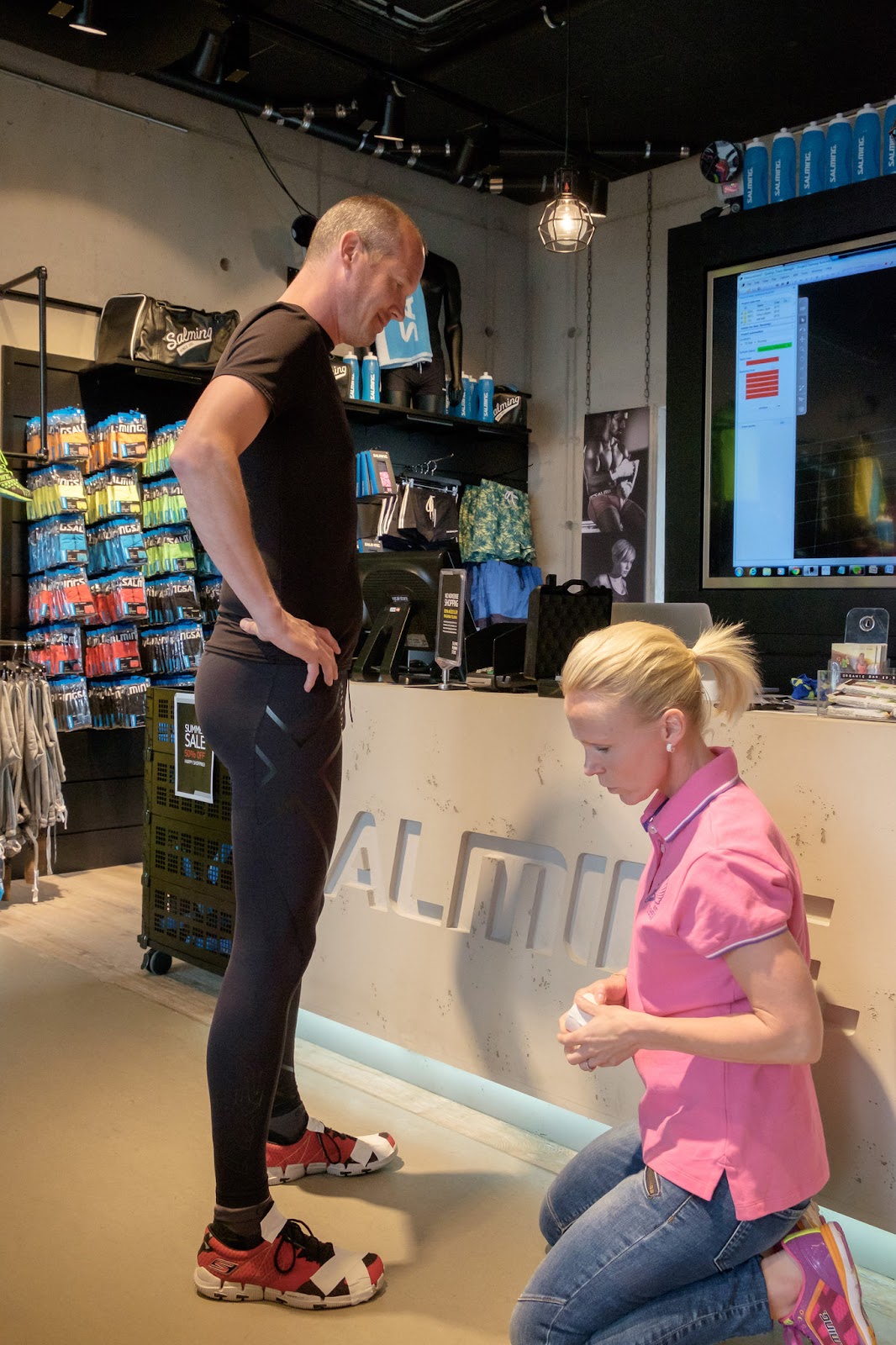
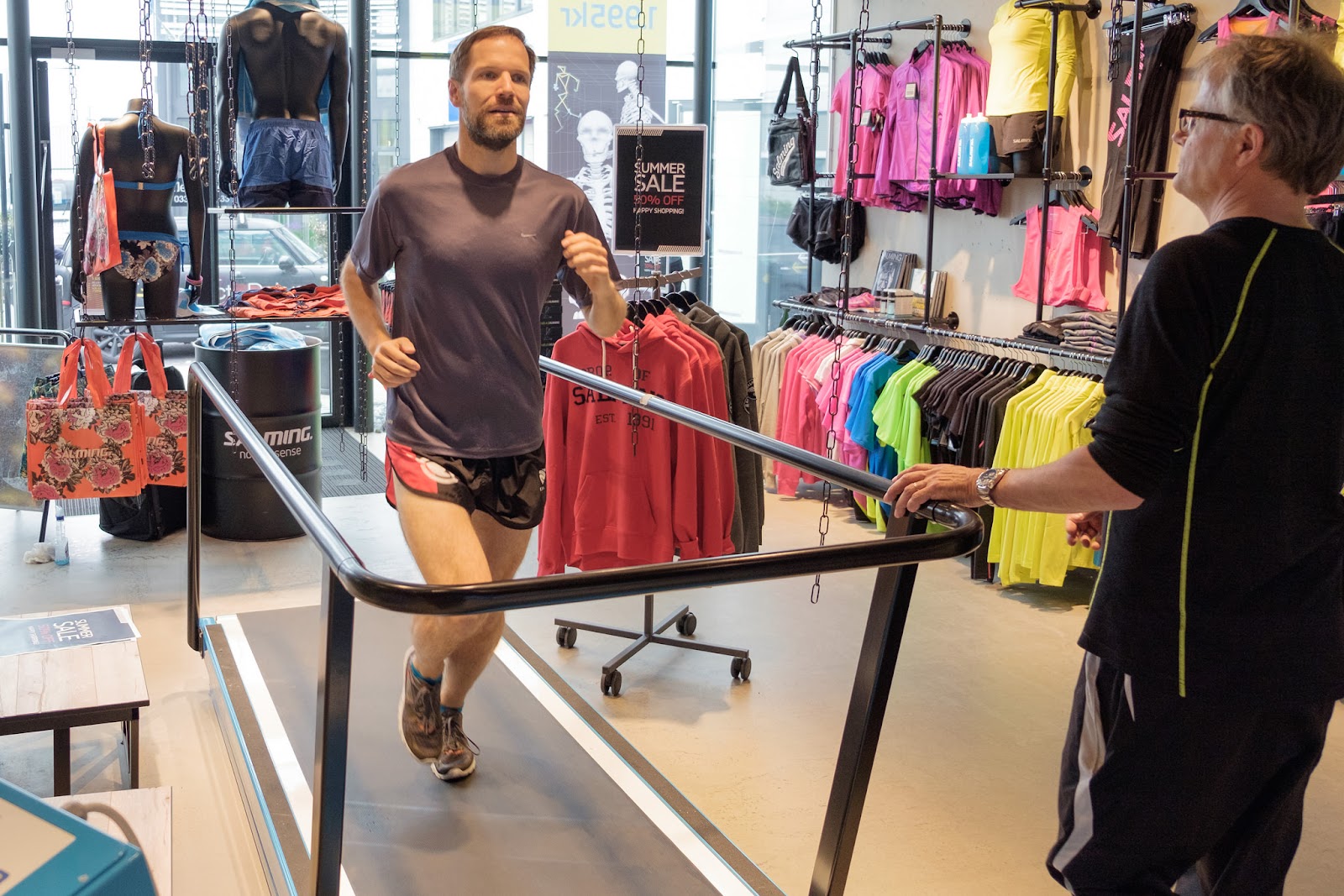
On June 24th, 2015, Carsten and I showed up to the Salming headquarters and flagship store in Gothenburg right after lunch. The prior week we had used their intuitive web interface to book sequential times so that we could share the experience.  After a brief introduction to the process by Salming Retail Manager, Lhina Hansson, we were sent to the changing room to change into bottoms and shoes with as little reflective material as possible. The idea behind the RunLAB is to provide more insight into one’s running form to improve the economy and ease of running, and for injury prevention. The running form is analyzed through a quite sophisticated motion capture process. Think about how Gollum was created in the Lord of the Rings movies and then you understand the technology behind what is used!
jaytape.jpg
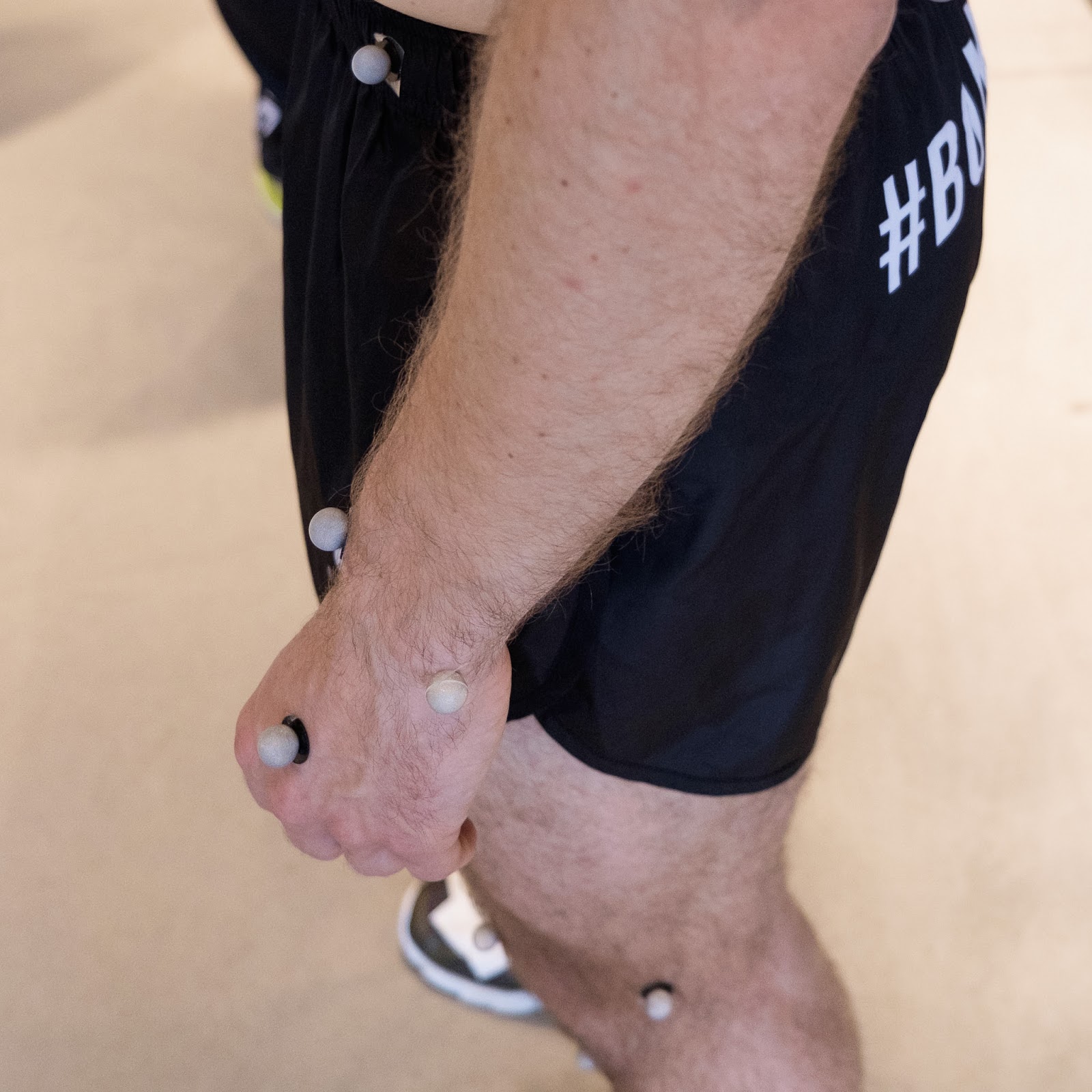
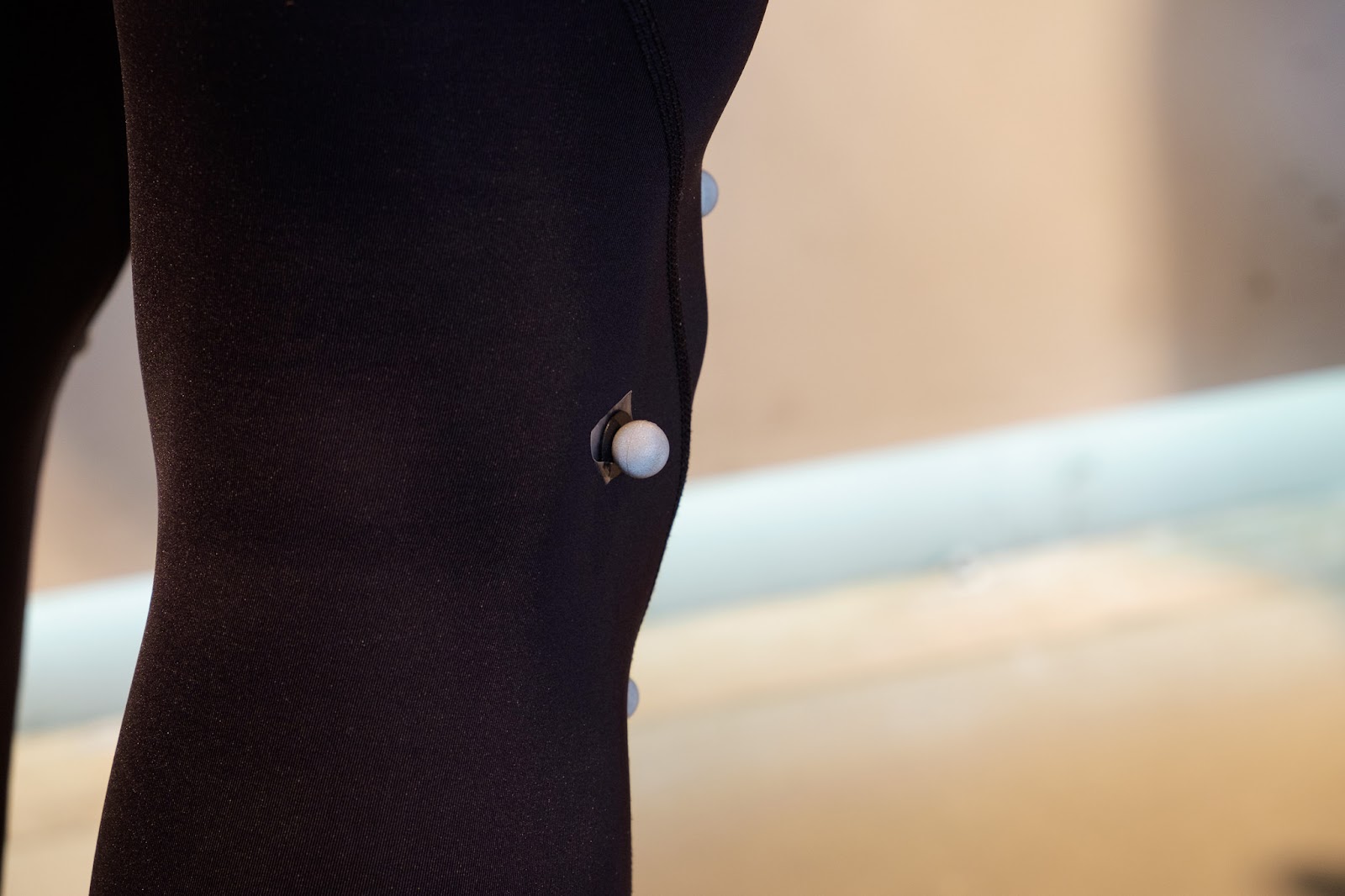
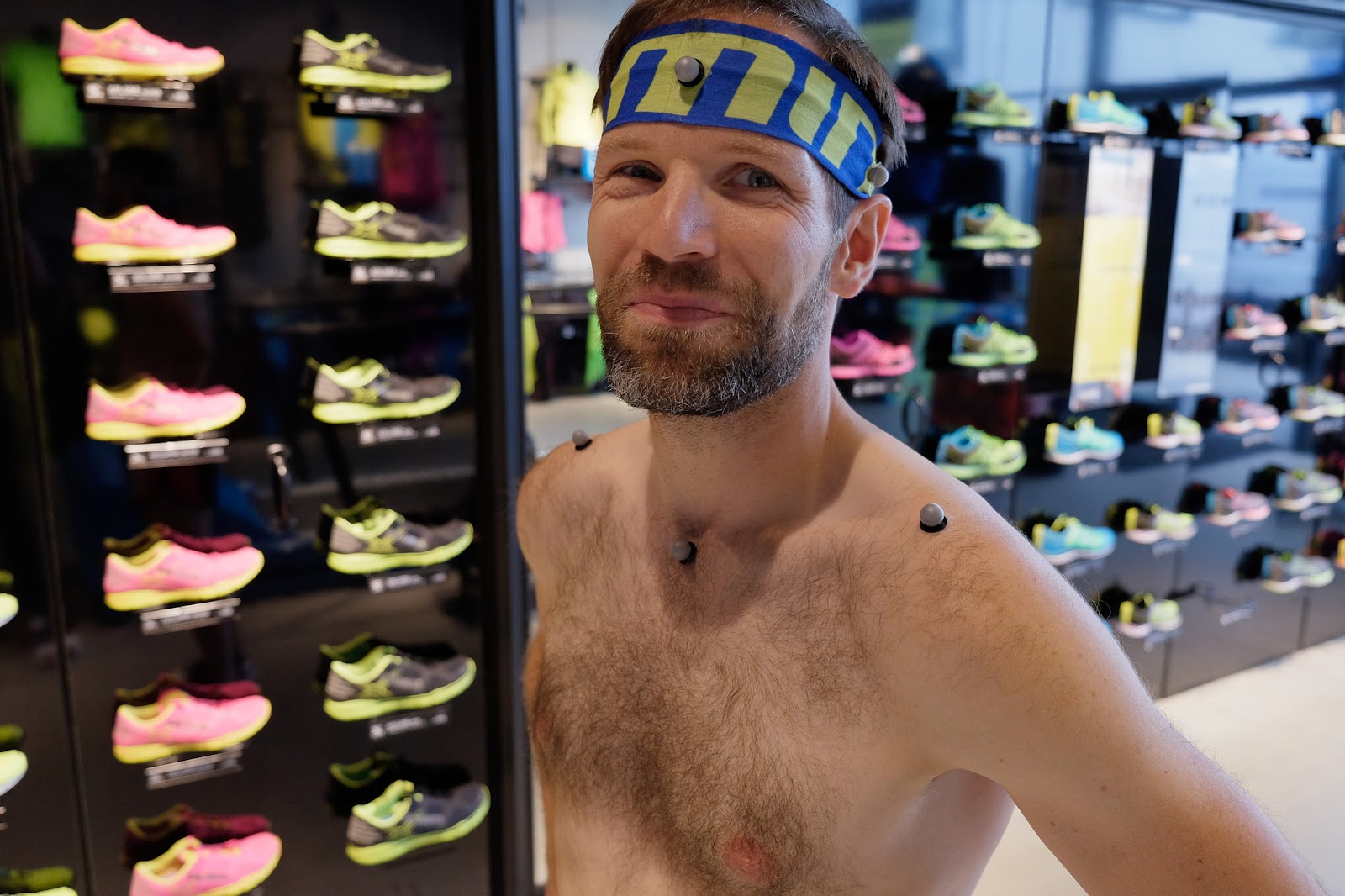
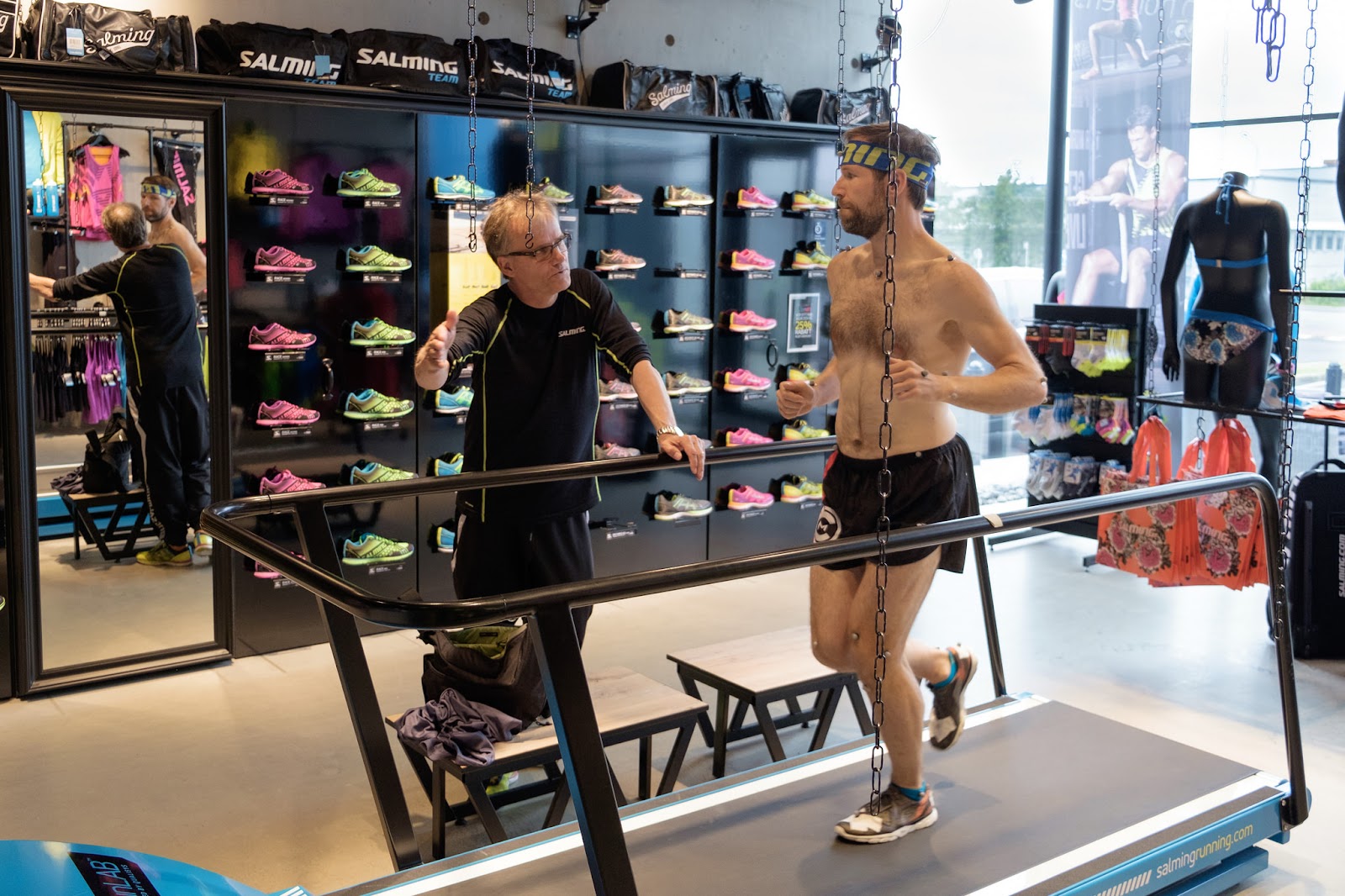
Once I came down from changing, Lhina and her colleagues, Peter Fröberg, a running coach for over 20 years and Sara Holmgren, one of Sweden’s top middle distance runners, proceeded to cover critical points on my body with reflective balls meant to provide markers for key movement points. All other reflective material on my running gear was covered now to take away any false markers. These markers are also the reason why the test needs to be done in shorts or tights, and with bare upper body (or sports bra/tight shirt if you are a woman); it is crucial that the markers reflect the actual motion of the body and not that motion of the garment you are wearing.
carstenmarkers2.jpgjaymarkers.jpg
carstenmarkers.jpg
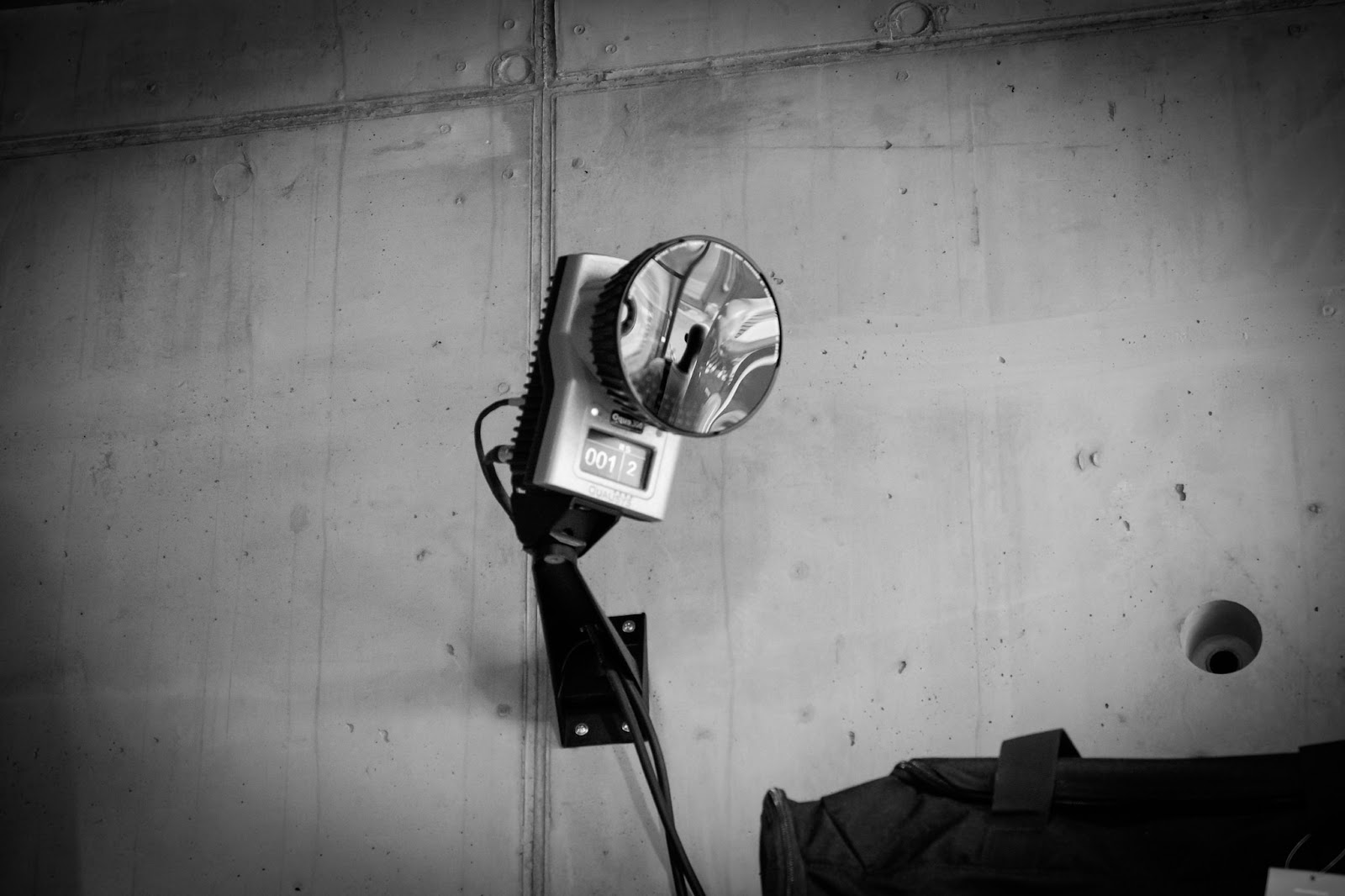
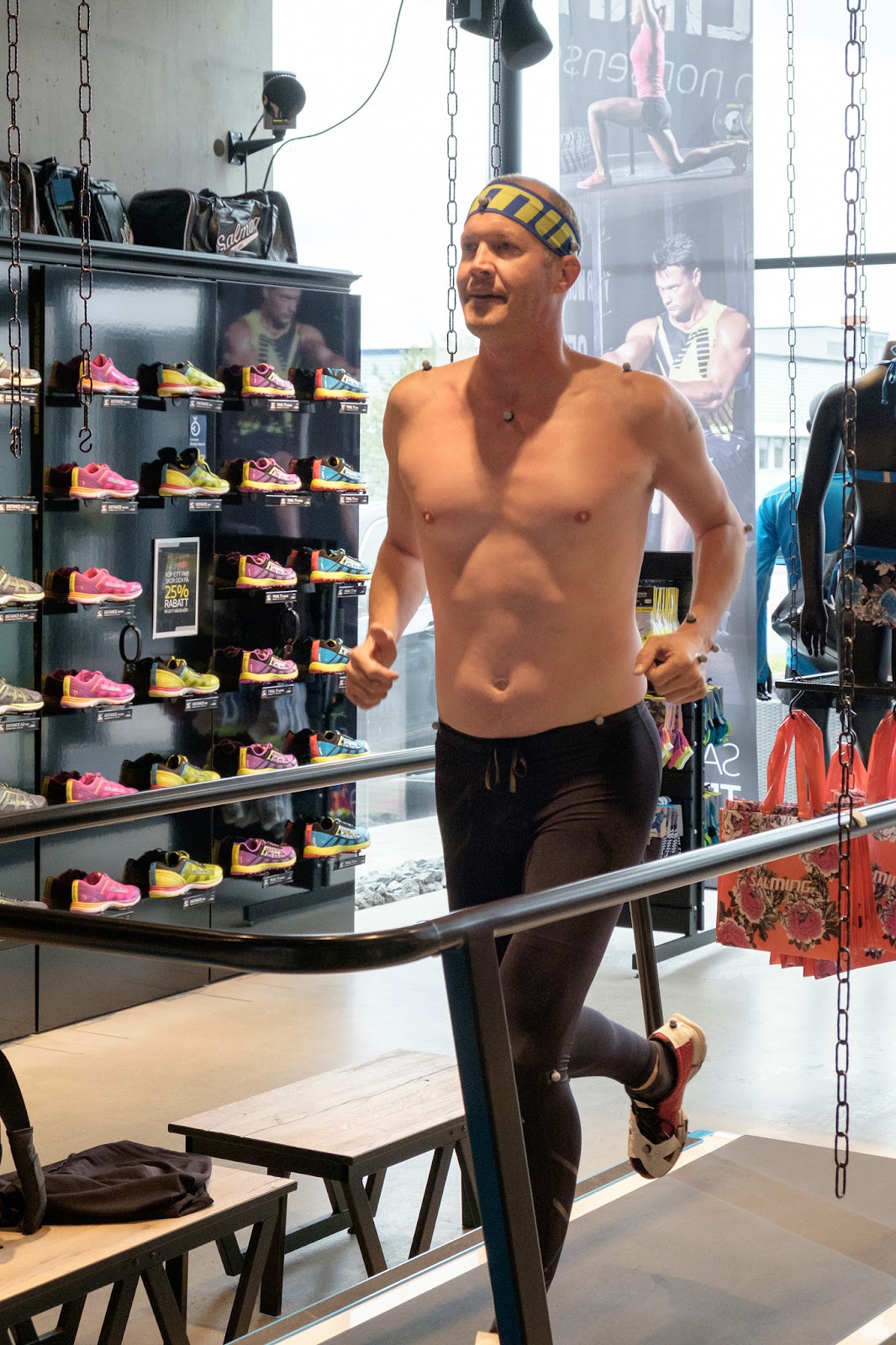
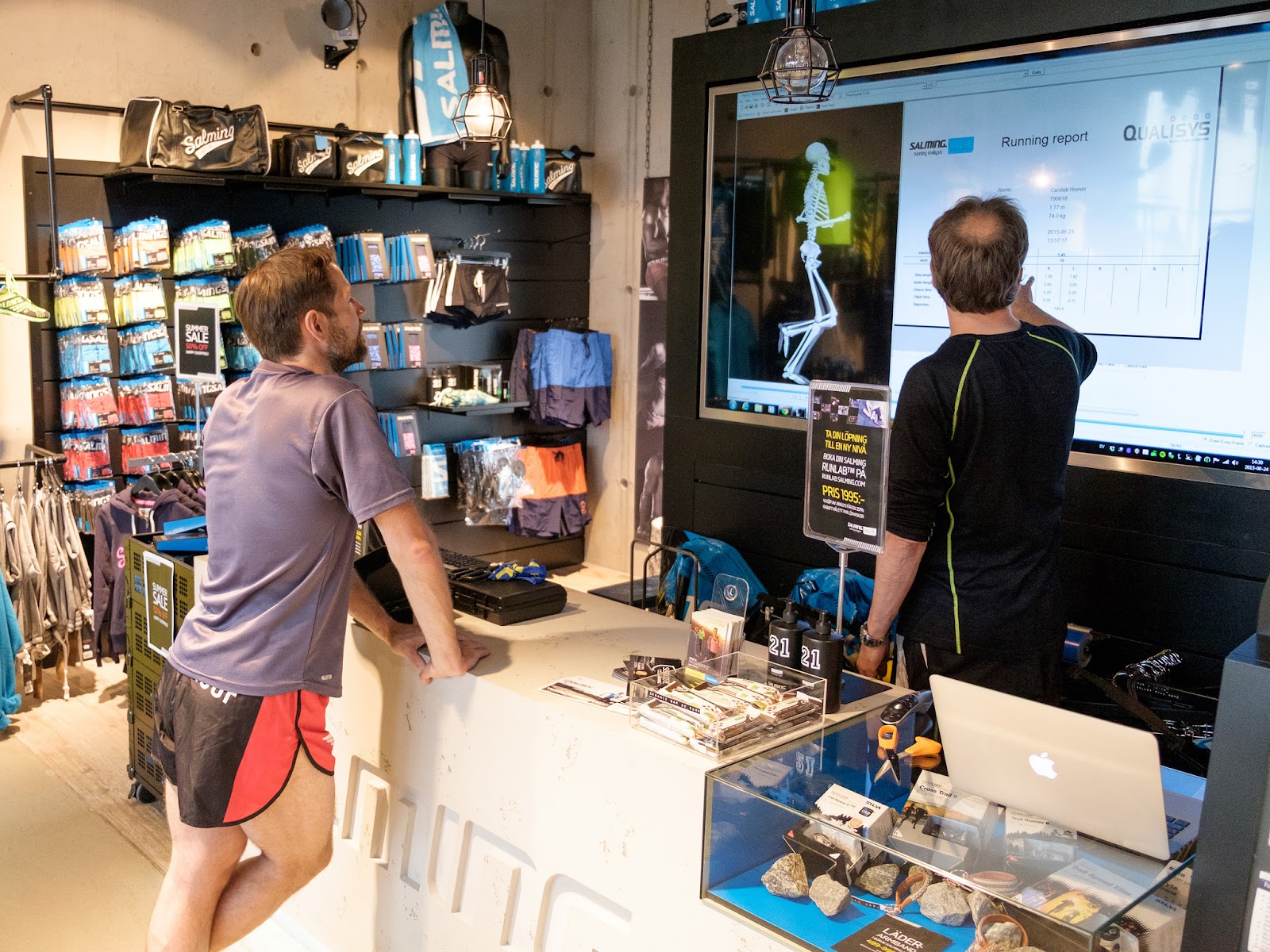
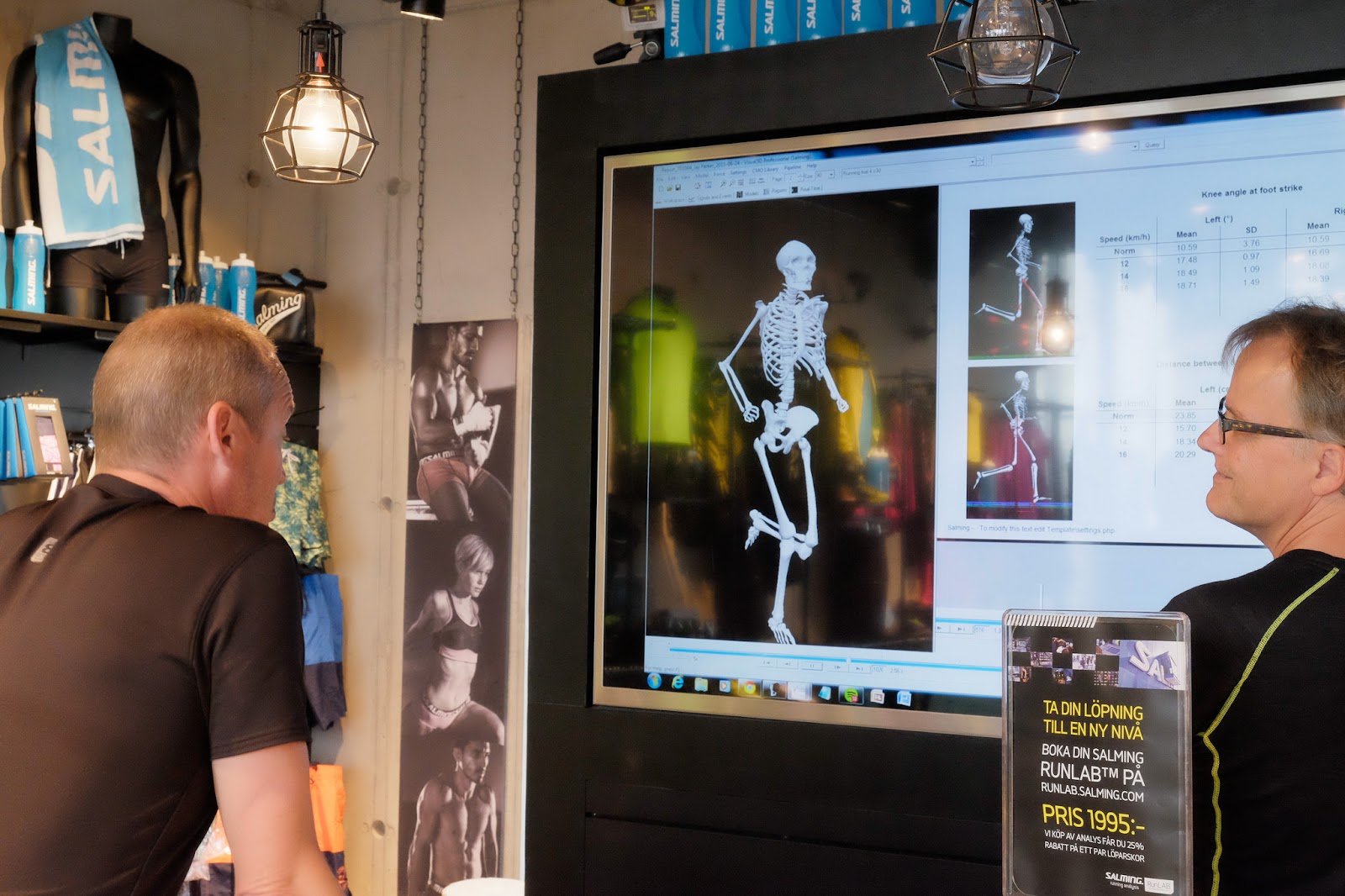
Once “marked up”, Peter then explained that I would warm up for about 5 minutes at an easy pace and then they would record three segments of progressively increasing speeds of approximately two minutes in duration. I mounted the sweetest treadmill I have ever run on and proceeded to warm up. The treadmill used was a (insert treadmill details here), which has about 1.5 times the length of a normal treadmill with a shock absorbing deck. The lab itself is located right in the centre of the flagship retail store in front of the cash registers. Surrounding the treadmill there are 10 motion capture cameras utilizing the reflective markers as well as a couple of normal video cameras. Behind the register are large screens that show a live video feeds and confirm that all markers are recorded. This provides a new experience of seeing yourself from a third party perspective while you run and can be a bit unsettling initially! Once warmed up and all markers were confirmed, Peter instructed me to begin the first segment at 5:00/km (about 8:02/mile).  Once recorded, we moved on to 4:17/km (6:53/mile) and then finally 3:45/km (6:02/mile). The paces are determined by an individual’s 10K personal record and are unique to every person who comes to the lab. Immediately after finishing, Peter had some initial comments about my arm swing that he concluded just from visual observation and asked me to try a couple of changes right away. This improved my leg “wheel” openness immediately and I was commended on my ability to learn :). We had decided to postpone the data analysis until both Carsten and I had completed the data recording, so next it was Carsten turn to run. His data recording went similarly to mine, and we ran at the same paces, even though he’s a bit faster than me.
motioncapture.jpgjayrunning.jpg
After the data recording segments, we showered and then stood with Peter and Lhina by the large monitors to look at the results.  Peter took me through my results in English and Carsten’s in Swedish. The results are provided as online reports (in Swedish, Link to Salming RunLAB Results: Carsten and Jay). The data is identical to what we went over in the lab, but is presented in a nicer format. In the online version, the focus is on the summary of the suggested improvements with details following, whereas in person, we went through the details first and then concluded with improvements.  The areas captured and analyzed are categorized as follows:
A.                         Arms & Hands
B.                         Legs & Feet
C.                        Hips
D.                        Overall Body
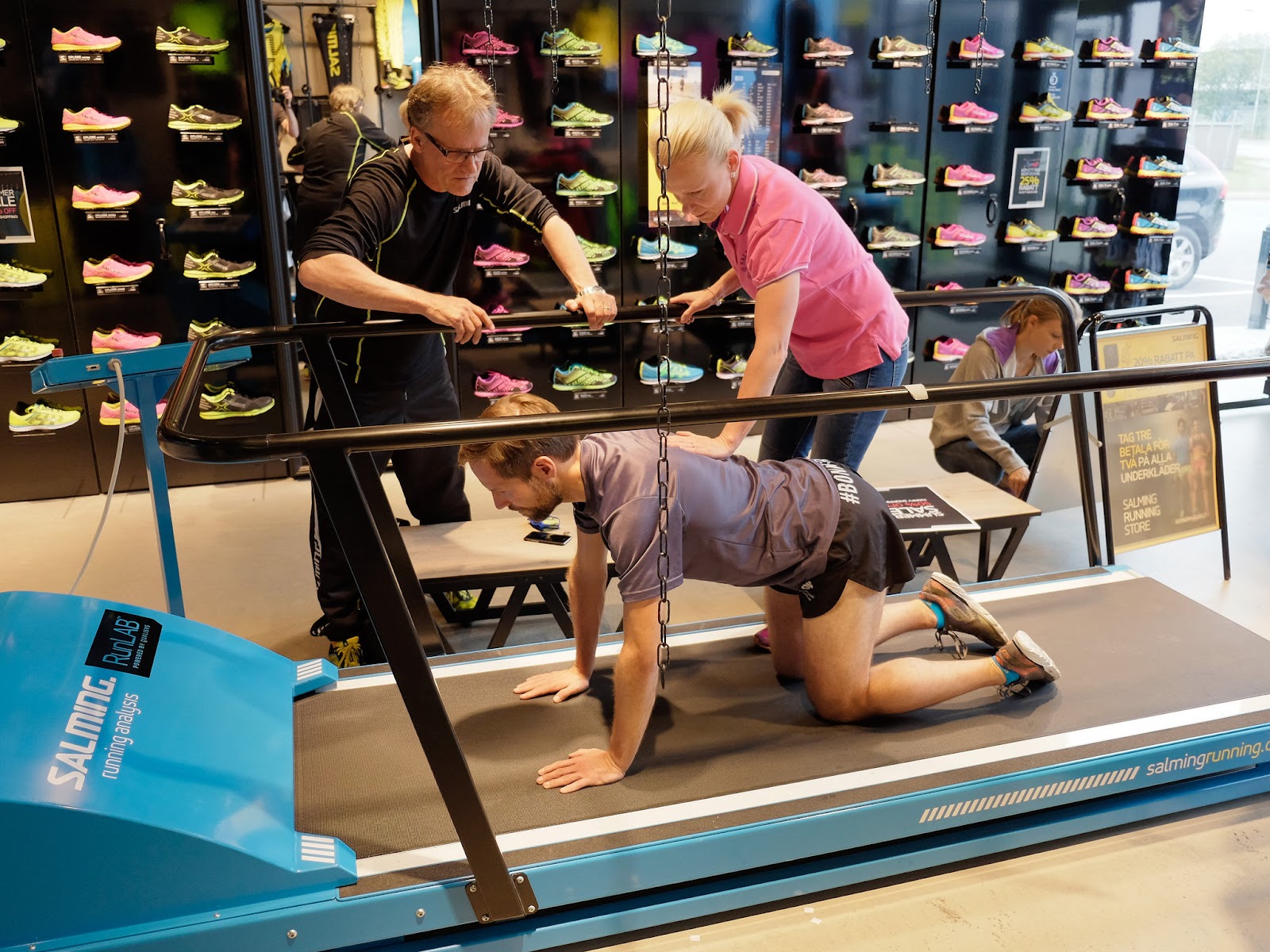
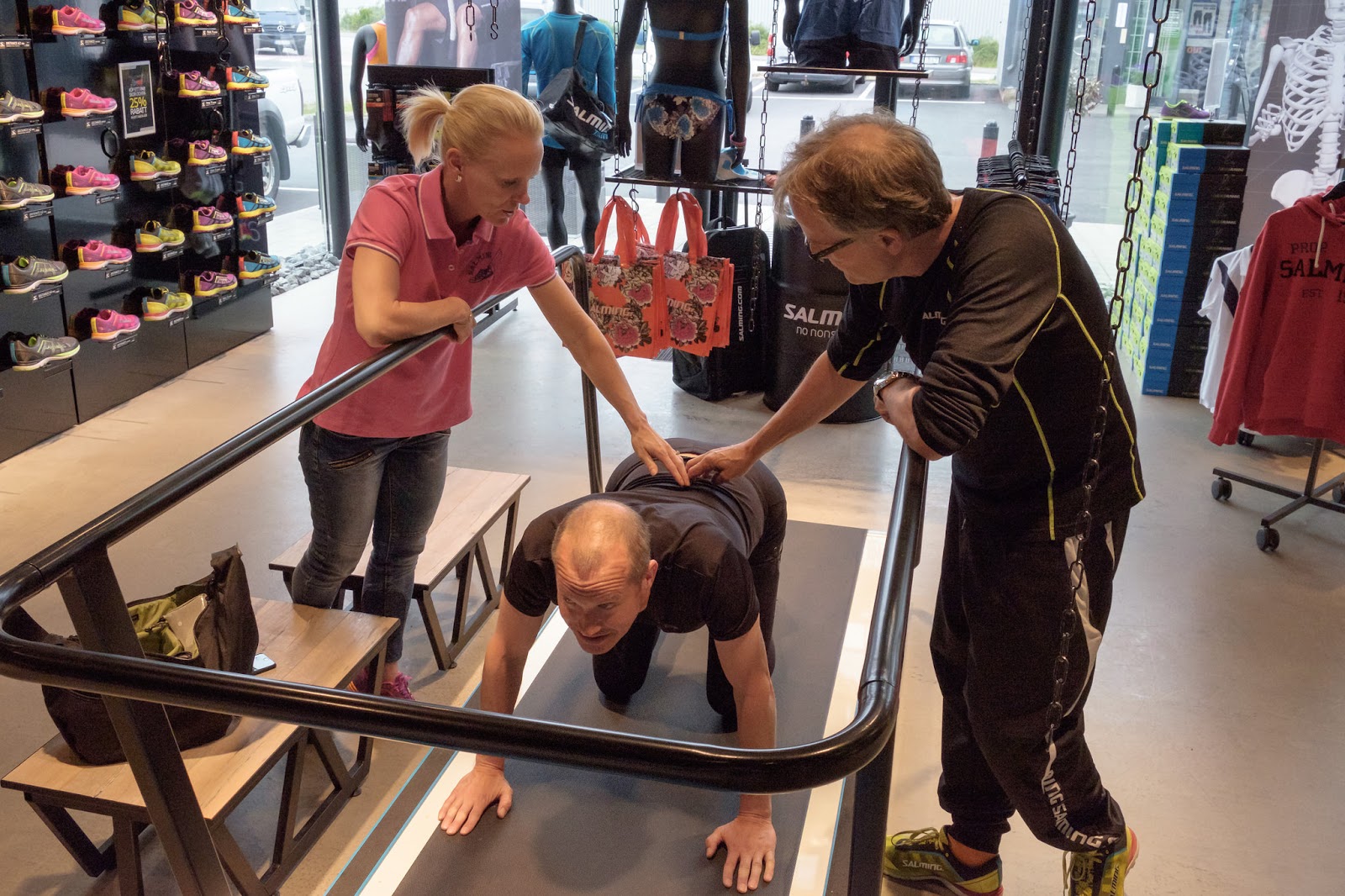
By looking at each categories’ graphs, you can see the differences in result by the different paces as well as a comparison to Swedish elite athletes that have been through the same analysis. The data itself is interesting, particularly if you are a data geek, but the real value came through the experience of Peter as a coach going through each result and explaining what it meant and how changes in form affect each area.  Peter took his time and was patient and knowledgeable when handling our (many) questions and gave us a thorough insight into what conclusions could be drawn from this kind of data capture driven analysis. To back up some findings from the recorded data, we where instructed to perform some additional exercises while being closely scrutinized by Peter and Lhina.
carstenanalysis.jpgjayanalysis.jpg
In my case, the biggest change to be made was in the area of arm swing and hip angle.  Peter suggested that I make sure to bring my elbows back to my body on the upswing of my arms and then allowing my forearms to swing more freely forward.  At the same time, I was angling my pelvis too far forward and needed to push my hips forward a bit in order to vertically align my body and allow a larger foot wheel and freer arm swing.  These suggested changes were demonstrated to me and then I was coached through them on the treadmill so I understood and could create some movement memory.
Carsten had similar shortcomings with his arm swing and the pelvis rotation, but interestingly, both the causes for these shortcomings and the suggested changes were different from those I got. This stresses that the actual data recording is only one part of the RunLAB experience, the real value comes from the experts who analyze the data for you.
carstenexercises.jpg
jayexercises.jpg
CarstenrunningPetercoaching.jpg
The briefing on form improvement concluded the actual RunLAB experience. A couple of days after the session Carsten and I got the weblinks to our reports, which, at least in Carsten’s case, also included some exercises which should help him improve his pelvis rotation.
It is possible to book a follow-up RunLAB session in order to see whether the suggested changes have improved the running form or not. Carsten and I will hopefully be able to do this second analysis in the near future.
carstenrunningafterexercises.jpg
In summary, this has been a very valuable experience. Just by looking at the setup of the treadmill in the middle of Salming’s flagship one might conclude that this is just another fancy way of fitting running shoes. One couldn’t be more wrong. Just to fit shoes this setup is complete overkill (and accordingly also not used by Salming for this purpose). Instead it is a very advanced biomechanical analysis which can tell you more than you possibly want to know about your running form (“A heelstriker, I? Never!”). The real value, however, is only partly in the recorded data. The input from the experts is what makes this experience worth its money. Alas, this also brings us to the one negative point: as you might imagine the analysis is quite expensive, roughly $220 for one session, or $330 for two. However, considering that this is a rare chance to truly improve your running form it might be well worth the money. Most runner’s are pretty bad at realizing the importance of proper form, yet in the long run it is probably more important than another training cycle full of interval workouts. As such the cost of two or three pair of running shoes seems be reasonable. It is definitely more worth the money than similarly priced V02max tests.